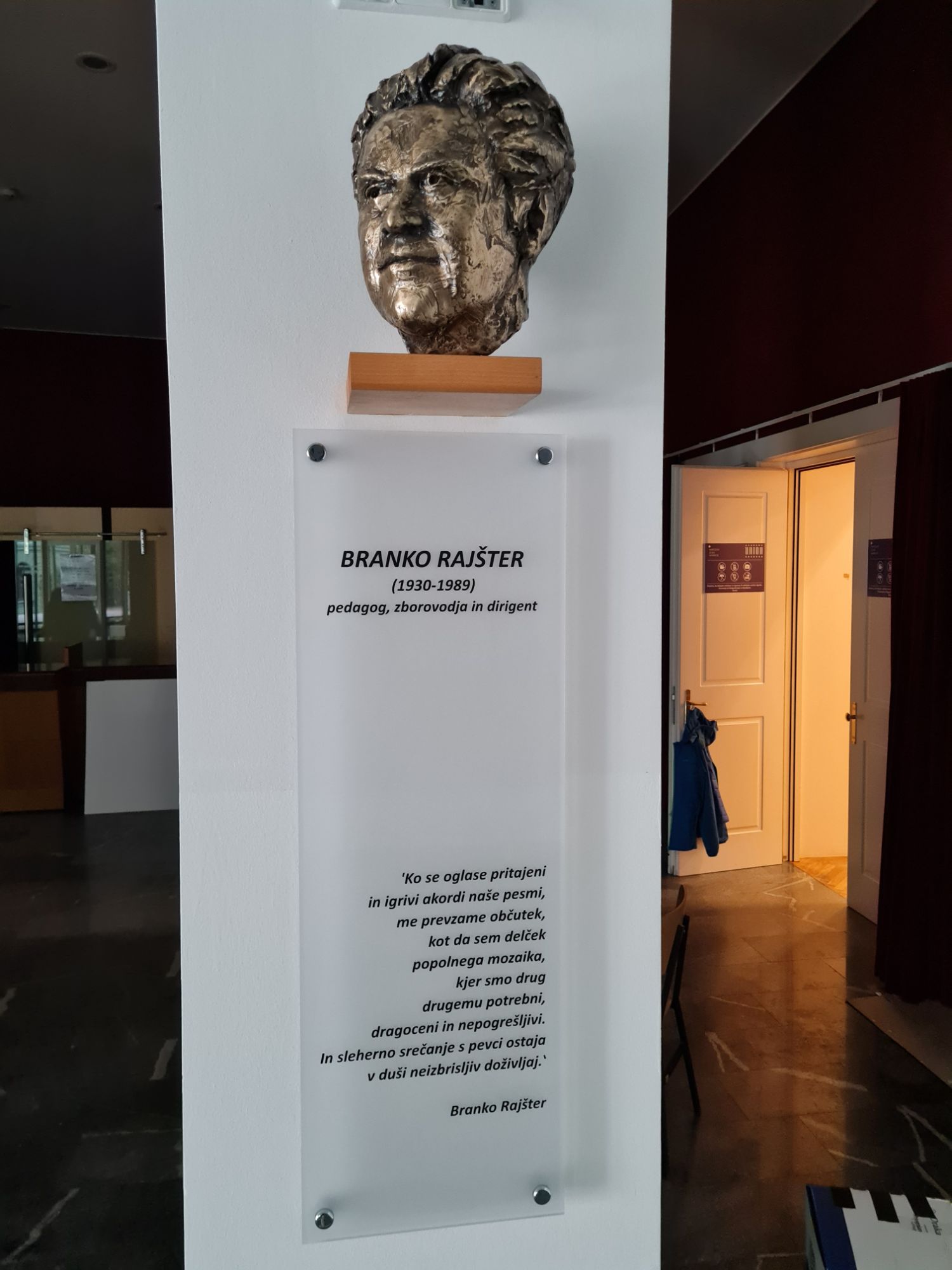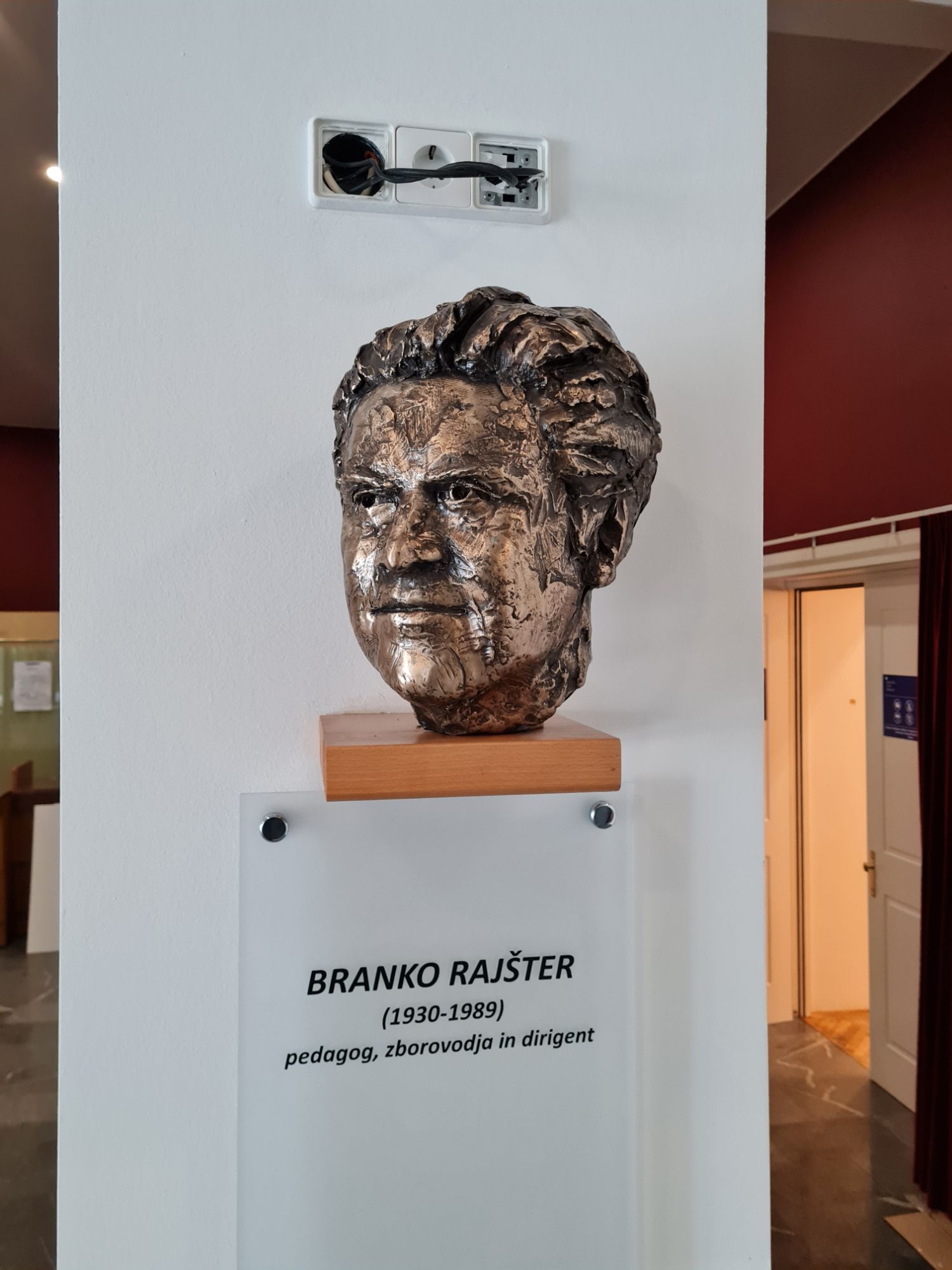
On 4 December 2019, on the occasion of the World Choral Day and in commemoration of the 30th anniversary of the death of Branko Rajšter, a monument was erected in the foyer of Maribor’s Union Hall by Public Fund for Cultural Activities of the Republic of Slovenia – JSKD and Association of Cultural Societies – ZKD Maribor. The monument was made by an academy-trained sculptor, Viktor Gojkovič.
Branko Rajšter
Branko Rajšter (1930–1989), a renowned educator, composer and choral conductor, made an enduring mark on Slovenian choral singing.
He gained appreciation of music at a young age under the mentorship of his uncle, musician Jože Matjašič, who taught him to play the accordion. In primary school, he developed a fascination for the tamboura orchestra and learned to play brač, a lute-like folk instrument, and guitar as an autodidact. After finishing junior music school, he attended the National Teachers Training College where he played in a pops orchestra and also formed his own dance orchestra. In 1962, Rajšter completed his musical studies at the then Academy of Education in Maribor, and later graduated in composition from the Academy of Music in Ljubljana. He pursued postgraduate studies at the Faculty of Music, University of Arts in Belgrade, obtaining a master’s degree in conducting in 1983. He then worked at several schools and initiated many children’s and youth choral showcases in Slovenia.
Rajšter’s influence was particularly significant at the beginning of the 1960s when he thoroughly overhauled choral singing in schools. In 1964, Rajšter and some of his colleagues founded the Youth Choir (present-day Carmina Slovenica), which continues to be one of the world’s most prominent vocal ensembles. He conducted the Maribor Youth Choir over a period of twenty-five years and obtained impressive results at competitions and festivals throughout Slovenia and the world.
He also worked at the National Education Institute, promoting modernisation of music education in primary, secondary, and music schools. He delivered lectures on the methodology of music education and choral conducting at home and abroad. In 1988, sharing his knowledge of and insight into vocal technique, Rajšter lectured at the Faculty of Education in Maribor, becoming Chair of the Faculty’s Music Department a year later. In recognition of his professional work and achievements, Rajšter received numerous awards and distinctions.