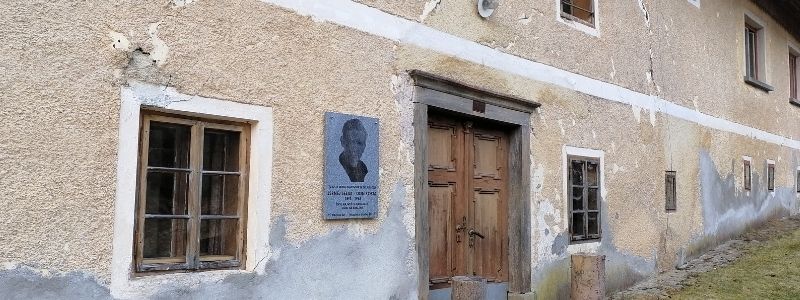
On 8 September 2018, on the 50th anniversary of his death and the 125th anniversary of his birth, a memorial plaque was unveiled on the birthplace of priest and musician Jernej Seljak, also known as Don Kosta Selak, in Sovra.
Don Kosto Selak – Jernej Seljak
Franciscan amateur musician, choirmaster, organist and composer Don Kosto Selak (1893–1968) created a prodigious output of church and secular vocal music and zealously promoted Slovenian song primarily in Dalmatia.
Jernej Seljak was born in 1893 in Sovra, a settlement in the Municipality of Žiri (the local name for the family homestead was ‘Abraht’). In his youth, he was known for his outgoing personality among his fellow townsmen. According to an old rural tradition, Seljak was singled out as the family son destined for priesthood. After completing the Diocesan Grammar School in Šentvid and studies of theology in Ljubljana, he celebrated mass, on Pentecost Sunday in 1917, as a newly-ordained priest in Žiri where he then left his mark also as a polyglot and musician.
After the First World War, he found himself among the Franciscans in Dubrovnik and other places in Dalmatia and eventually settled down as a parish priest in the village of Janjina in the Pelješac peninsula. He stayed there, his new-found home away from home, for twenty-seven years, between 1933 and 1960. He was so popular that the townspeople of Janjina offered to build a small house for him after his retirement, to convince him to stay. He earned popular acclaim also when intervening with the enemy on behalf of the townspeople during the Second World War. He died among his Franciscans brothers in the Brezje monastery, his final resting place.
His work in the field of music focuses mainly on choralism, a practice about which he wrote, reporting from abroad, in various Slovenian magazines, including Cerkveni glasbenik (Church Musician) and Pevec (Singer). He also ran a singing school at Kuna in Dalmatia. In his letters, he reported on successfully started choirs and concerts featuring repertoires by Premrl, Kimovec and Hubad. With various choirs, Seljak performed Slovenian compositions, most notably Oj, triglav moj dom (Oh, Triglav, My Home) by Jakob Aljaž, as well as more demanding repertoire, including lieder by Foerster and Sattner, published in Novi Akordi (New Chords). In his letters Seljak also stressed the immense popularity and recognition that Slovenian songs enjoyed amongst Dalmatians.
Seljak’s body of work includes approximately 160 preserved manuscripts and printed sheet music, consisting of both liturgical and secular music works. These comprise mostly solo vocal and choral compositions, as well as Latin and Slovenian masses. While credited with several good-quality compositions – most notably a Latin mass in six movements Missa in Honorem S. Blasii Servatoris, the vocal-instrumental Marian songs Marijine pesmi: Marijo slavite, Nebes in zemlje kraljici, Nebes in zemlje kraljica, Marija pomagaj na Brezjah and Velikonočni Mariji (In Praise of the Virgin Mary, To Queen of Heaven and Earth, Queen of Heaven and Earth, Mary Help of Christians at Brezje and the Easter Praise of Mary) – Seljak’s extremely simple music texture runs throughout his musical legacy. This suggests the pursuit of a more experienced music lover rather than a trained composer, which is why the quality of his work is not comparable to those of contemporaneous artists in Slovenia and Croatia.
Maia Juvanc